
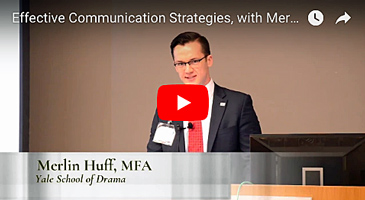
Effective Communication Strategies—Merlin Huff, MFA
April 13, 2018 by
[et_pb_section bb_built=”1″ _builder_version=”3.0.106″][et_pb_row _builder_version=”3.0.106″][et_pb_column type=”1_2″][et_pb_video _builder_version=”3.0.106″ src=”https://youtu.be/d7IvSbnY-lI” /][et_pb_text _builder_version=”3.0.106″ background_layout=”light”]
What is the best way to engage in a conversation when deeply held beliefs and ideas clash? Is there a way to frame a conversation that allows for real communication—not just “winning” or “losing” an argument?
[/et_pb_text][/et_pb_column][et_pb_column type=”1_2″][et_pb_cta _builder_version=”3.0.106″ url_new_window=”off” use_background_color=”on” background_layout=”dark” custom_button=”off” button_icon_placement=”right” background_color=”#2d9b8a”]
Merlin Huff earned an MFA from the Yale School of Drama, and has worked as both a film and stage actor. Owner of Huff Studios, Merlin helped actors and non-actors understand and step into the shoes of personalities and viewpoints very different from their own. Merlin spent two years as a management consultant, and now holds the role of Integrator at a real estate company in South Dakota.
[/et_pb_cta][/et_pb_column][/et_pb_row][/et_pb_section]
The Investment in Health: Doctors also need to be involved in healthcare policy discussions
April 9, 2018 by
In early February, I was fortunate enough to attend AcademyHealth’s National Health Policy Conference in Washington, DC, due to a generous scholarship from Benjamin Rush Institute. At this conference, I learned about the intricacies of Medicaid state innovation waivers, how multi-payer episodes of care payment models are being implemented in various states, and the difficulties of passing any healthcare bill in the current political climate. What struck me most, however, was not the specific content of any one lecture, but rather the range of people with whom I was in attendance. The seemingly marginal number of healthcare providers amongst the lawyers, economists and other policy makers surprised me.
Although I recognize the importance of professional collaboration in forming any national policy, it was discouraging that there were not more physicians at the forefront of the conversations regarding the future of care in our country. The policies resulting from these discussions have the potential to impact doctors’ most basic patient interactions and can affect our ability to provide what we believe to be the best possible care.
Not only do we need to actively encourage more physicians to take a seat at the table in this discussion, we should also be empowering and educating our patients to be involved as well. We had the pleasure of listening to the Surgeon General Dr. Jerome Adams discuss how he plans to tackle the opioid epidemic in America. His message emphasized how the vast majority of the American public does not vote based on considerations of health, but rather on jobs, the economy and national security. He quoted the staggering statistic that in the United States, seventy-percent of eighteen to twenty-four year-olds are ineligible for military service due to health concerns. In this way, health is drastically impacting our national security. We need to reframe healthcare in such a manner so that everyone in our country understands its true impact on society. This will incentivize more people to invest themselves in discussions of how they believe care should be provided.
I have always felt a strong duty to engage in the issues affecting my ability to care for my patients, but after this conference, I now know that also means actively encouraging my colleagues to take part in this discussion as well. In order to be true advocates for our patients, we as healthcare professionals must stand for them at the individual, local and national levels. We need an active role in the policy making process to ensure preservation of the sanctity of the physician-patient relationship.
February 5, 2018 by
All are welcome to join us at this free panel discussion of the relationship between the tenets of social justice and their impact on the patient-doctor relationship. This event will be held on OSU’s campus in Meiling Hall #160, is free to the public and greater student body.
Is the cultural trend toward social justice beneficial or toxic to the patient-doctor relationship?
Presentations: 6:00pm – 7:30pm
OSU Meiling Hall, Room #160
370 W 9th Ave, Columbus, OH 43210
A panel discussion is not a debate. The purpose of the evening is not to create winners and losers—but to deepen everyone’s understanding of today’s pressing healthcare issues. Too often in healthcare discussions, terms are used without clarity, or without really thinking through the possible downsides of what is being proposed. By investigating various view points we can best sort out the strength and weaknesses of various options, and come to our own conclusions about what best serves the patient-doctor relationship.
Representing that the tenets of social justice are compatible with the ethical requirements of the patient-doctor relationship:
Daniel Skinner, Ph.D., is Assistant Professor of Health Policy in the Department of Social Medicine at Ohio University’s Heritage College of Osteopathic Medicine, in Dublin, Ohio, Adjunct Assistant Professor in the Department of Pediatrics, The Ohio State University (at Nationwide Children’s Hospital), and Assistant Director of the Health Policy Fellowship, a certificate program of the American Association of Colleges of Osteopathic Medicine. His areas of expertise include health care politics and policy; the politics of medicine and disease; hospital-community relations; and health care for vulnerable and underserved populations.
2nd panelist for this position TBA.
Representing that the tenets of social justice are not compatible with the ethical requirements of the patient-doctor relationship:
Dr. Ryan Nash, MD, MA, FACP, FAAHPM, is the Director of The Ohio State University Center for Bioethics and Director, Division of Biomedical Education and Anatomy. He is an Associate Professor of Medicine and holds the Hagop Mekhjian, MD, Chair in Medical Ethics and Professionalism at the College of Medicine. In addition to practicing Palliative Medicine, Dr. Nash is a Clinical Bioethics consultant and Healthcare Ethics Advisor for the OSU Medical Center. He has published one book, three book chapters, and several essays related to bioethics and has presented numerous scientific papers and invited lectures at national and international meetings. In addition, Dr. Nash currently serves on the Ethics Committee for the American Academy of Hospice and Palliative Medicine.
2nd panelist for this position TBA.
Moderator: TBA
February 5, 2018 by
For the first time, Benjamin Rush Institute is opening its Friday Keynote Luncheon address with Dr. Raul Artal to the greater OSU, OUHCOM, other local universities, and the greater Columbus community.
Friday’s luncheon event is part of BRI’s annual student Leadership Conference and is typically a private event for attending students only. This year’s conference theme is Ethics of the Patient-Doctor Relationship, and we find the questions and dialogue that are part of this discussion to be so vital to influencing positive healthcare policy, that we are opening this up to reach more people.
Medical Ethics and the Holocaust: Lessons From the Past
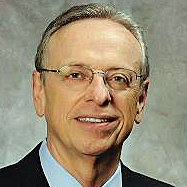
Raul Artal, MD, FACOG, FACSM will be our luncheon Keynote Speaker on the topic Medical Ethics and the Holocaust: Lessons From the Past.
Dr. Artal, a Holocaust survivor, was born in a Nazi concentration camp. He is the Chairman and Professor Emeritus of the Department of Obstetrics, Gynecology and Women’s Health at Saint Louis University. He is a graduate of Sackler School of Medicine, Tel Aviv University (where BRI has thriving chapter!), the author of over 200 publications and three books and is internationally recognized for his expertise in high risk obstetrics, exercise physiology, and ethical standards in medical practice/research.
Viewpoint: Medicine After the Holocaust
Lunch is guaranteed to those who RSVP 48-hours in advance. REGISTRATION FORM.
(Students already accepted to the leadership conference do NOT need to register.)
For more information about the conference, please see our 2018 Leadership Conference web page.
Direct Primary Care means quality for patients, happiness for doctors
January 11, 2018 by
Throughout my first months at of medical school, I have been very struck by the impact the current healthcare system and costs have on physicians and patients. Many doctors feel limited in what they can do for their patients due to costs, while patients are often faced with difficulties accessing healthcare due to the price and time needed for treatment.
This past year, I experienced these difficulties first hand when I purchased my own insurance. I spent a gap year working in my family’s restaurant and was making too much money to be covered by their insurance plan. As such, I bought my own through the ACA’s Health Insurance Marketplace. The experience was confusing, time consuming, and opened my eyes to the many barriers preventing people of different backgrounds from obtaining healthcare.
Through the generosity of the Benjamin Rush Institute, I was able to attend the Docs for Patient Care Foundation’s (D4PC) conference on Direct Primary Care to learn about one solution for our current healthcare system. Through a non-insurance direct payment agreement with a physician, DPC allows patients better access to their doctors, while avoiding the high, debilitating premiums often associated with medical care. Physicians, on the other hand, can focus on being an advocate for their patients without being tied down to the bureaucracy often associated with our healthcare system.
Perhaps the most striking thing of the entire experience, however, was just how happy the direct primary care doctors were.”
Perhaps the most striking thing of the entire experience, however, was just how happy the direct primary care doctors were. I have seen many physicians who are burnt out due to the problems in our current healthcare system. Many regret entering the profession and would not recommend it to their children. In contrast, the DPC doctors I met at the conference had an optimistic outlook on life and their careers. Many commented on how direct primary care allows them to build quality relationships with their patients and treat the person as whole, not just when sick.
I was also very inspired to see the entrepreneurial spirit of the direct primary care doctors—most who own their own practices and are excited for the growth opportunities before them. While direct primary care is not currently available in my home state of Wisconsin, I foresee a bright future for this style of care because of the quality of care it allows for patients and the inspiring physicians practicing it.
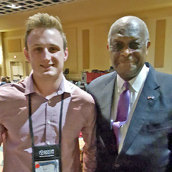
The opportunity to learn about healthcare policy from leaders like Herman Cain and Grace-Marie Turner was truly a special experience, and I hope to carry theirpassion for improving our healthcare system with me as I begin my journey in medicine.
Exploring the insurance side of medical practice: India vs. the U.S.
December 27, 2017 by morgan-kohls
I am a doctor from India. I have three years of work experience in primary care in India. Currently, I have been working on a Master’s in Public Health at Icahn School of Medicine at Mt. Sinai since 2015.
One of the main differences in the practice of medicine between India and the U.S. is the insurance system. Being an international medical graduate, I found it very difficult to understand insurance concepts and the way medical insurance works. Even after being in the U.S. for three years, I still find and learn new aspects of the way medical insurance works here.
In India, there are two main ways the medical system works: through state-run institutions and through private hospitals and practices. State-run hospitals do not charge patients except for advanced radiological and imaging studies. Even then, the charge for a CT scan is $10 and an MRI brain scan is $50. These payments are made in cash and done immediately before or after the test is performed. Generic medications are provided at no cost in the state-run hospitals, and some medications are sold at a subsidized rate. Private hospitals charge patients directly. ost payments are made immediately in cash or checks. There are some private hospitals like Aravind Eye Care System, which treat patients for $1. These low charges and free health care are possible in India because of the case loads and cash payment system.
In contrast, the U.S. health system is completely insurance driven. Although I had assumed that the U.S. health system is expensive, I was shocked at the huge bills for an ER visit and the cost of basic medications. I wasn’t aware nor had heard of cash payments in the U.S.
It was Benjamin Rush Institute that showed me that cash payments are possible in the U.S., too. BRI exposed me to the concept of DPC—direct primary care. After attending the DPC Nuts & Bolts to 2.0 conference in Orlando, I am sure that medical costs could be drastically reduced in the U.S., too. I was able to appreciate the cost reduction both for buying medications and for diagnostic testing when direct cash payments are made. The case studies of doctors practicing DPC was really useful to give the audience a context of how good the system is for both the practicing doctor and the patient.
I feel all primary care providers should make patients’ health their priority and work towards making this DPC venture a successful one. I feel still there is a long way to go before this could be implemented and practiced throughout the nation; yet, it could be achieved if the message reaches all physicians and the public. If the public demands these kinds of services, then doctors and institutions will slowly start switching over to DPC.
BRI is doing a wonderful job by targeting the right population: young medical school students. BRI could also plan on targeting the public, so they could have far reaching benefits for their efforts. Having practiced in India, I really am able to appreciate how good the system of DPC is for patients and their families. I am planning to do my residency in Family Medicine and start my own private practice. I will definitely be practicing DPC in the near future. Thanks to BRI for introducing me to such a wonderful opportunity in the US.