Kathryn Bennett on medical students and healthcare policy leadership
Thanks to the support of Benjamin Rush Institute and The Physicians Foundation, I had the wonderful opportunity to attend the Western Health Care Leadership Academy Conference (WHCLA) in San Diego, CA. This was undoubtedly one of the most enriching experiences of my first year of medical school and a perfect way to cap off the year. The conference attendees ranged from leaders in health policy, large national health care systems and insurance companies, award-winning authors, politicians, TV and Radio hosts, to physicians from all specialties and current medical students like myself. One of the best aspects of this conference, in addition to the exposure to the viewpoints from the diverse array of stakeholders, was the dedicated “Student and Resident Future Leaders” track targeted particularly for current med students and residents, which emphasized business skills, advocacy, and leadership while in medical school.
The Student/Resident breakout sessions were invaluable. Before attending the conference, I had very limited knowledge about what as a medical student I could do in terms of advocating and generating change. Dr. Bob Hertzka, BRI board member, former CMA president, and chair of AMA’s political action committee (among many other accolades) opened my eyes to my potential role in the political process of healthcare, and most importantly, that it can begin now. I left inspired to take the future of my profession in my own hands and look forward to learning more from him and the student leaders I met through that panel.
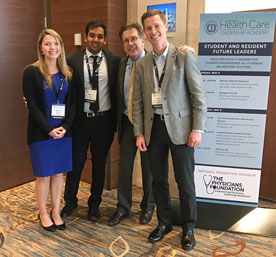
Katie Bennett, Ishan Mehta, Dr. Bob Hertzka, and John Flo at the WHCLA conference in San Diego.
“Conferences like WHCLA are invaluable for introducing medical students to leadership positions, not to mention potential mentors, all of which helps develop our potential in the larger picture of the healthcare system. As millennials, more than ever we desire agency in our careers.”
~Kathryn Bennett, medical student, UC-Irvine School of Medicine
The WHCLA conference took place during an opportune time, commencing on the day after the House passed the measure to repeal the ACA. The information I learned throughout the conference was both thorough and digestible. I was exposed to a balanced representation from both sides of the discussion, most notably through the debate around health care policy with Paul Begala and Hugh Hewitt. They had a passionate, articulate and good-natured discussion covering issues including how to replace funding for Medicaid, how to help individuals who are too wealthy to qualify yet, lacking an employer plan, cannot afford it, in addition to addressing coverage for preexisting conditions, invoking cost sharing pools and single payer systems.
Finally, the keynote speaker Dr. Abraham Verghese, conveyed a powerful message stressing the obligation for doctors to study outside of medicine when considering their patients. Through a number of historical scenes from his book, Cutting for Stone, in addition to more recent personal anecdotes, he addressed the importance of bedside manners and caring for the human condition. In sum, he encouraged physicians to build compassion and not forget the humanity of the patient, instead of only focusing on his disease. It was encouraging to hear the patient’s or family’s feelings discussed at length during a medical conference—a subject of rare appearance thus far in my medical career.
While in medical school it is easy to become siloed in studying for exam after exam and lose sight of the goal we are working toward, tirelessly striving to build the intellectual foundation we will need to treat our patients. But our careers will be so much more than the individual interactions we have with our patients. Most physicians will work in teams and eventually lead teams. Furthermore, most of us will be involved in committees that will direct policy, patient safety, operations, and healthcare outcomes at a high level. Conferences like WHCLA are invaluable for introducing medical students to leadership positions, not to mention potential mentors, all of which helps develop our potential in the larger picture of the healthcare system. As millennials, more than ever we desire agency in our careers. Taking time out to experience dedicated lectures on leadership and opportunities to network with great leaders from diverse perspectives not only provides the path to making the moves toward future success and career fulfillment, but also grows personal awareness around the policies that will affect our profession.
[Ed. Note: On March 21, 2017, The Indiana Star ran an article by Dr. Richard Feldman on healthcare economics. Dr. Feldman is an Indianapolis family physician and former Indiana health commissioner. In Part I, Trenton Schmale, DO, rebuts Dr. Feldman’s article with the history of American healthcare’s evolution. Here in Part II, Dr. Schmale demonstrates how free market principles will work in healthcare, when given the chance.]
How are free market models solving our healthcare problems?
Free market solutions to the problems of increasing healthcare costs, lack of price transparency, and diminishing insurance coverage already exist. Medical pricing transparency is increasing, and patients armed with this knowledge are advocating for themselves at local medical services, including hospitals. The Surgery Center of Oklahoma[5] lists each surgery’s cost up front. Direct Primary Care (DPC) clinics, like Westfield Premier Physicians[6] provide patients the choice of quality, affordable, convenient primary care in a monthly, quarterly, or annual care package. Northwest Radiology[7] and Any Lab Test Now[8] imaging and lab centers post prices online so patients can shop around for services. Even in a traditional hospital setting, patients who plan to pay in cash or still need to meet their high deductible can compare prices between places like the Surgery Center of Oklahoma and their local hospital. Increasingly, hospitals are reducing their prices at patients’ requests, rather than lose business to another facility. DPC and free market models are generating competition while lowering costs and increasing quality.
The free market also offers solutions to these issues via the health insurance market. For example, patients can join a healthcare sharing ministry like Liberty HealthShare, MediShare or Samaritan Ministries, instead of paying for traditional health insurance. Consumers should be free to customize their health insurance plans to cover what they actually need, which can reduce monthly premiums, raise or lower deductibles, etc., and insurance companies should be allowed to compete across state lines.
“As this wave of free market healthcare solutions emerges, it is important to make sure the government stays out of the way. The free market does work in healthcare if given the chance.” ~Trenton Schmale, DO, BRI chapter founder & past president Marian University College of Osteopathic Medicine
Bypassing traditional health insurance altogether and utilizing a free market coverage model protects patients when needing both acute care and more routine or specialized care—because they would be empowered to carry insurance coverage for scenarios that fits them best.
Where are free market healthcare models working?
The free market is already demonstrating effective alternatives! Just look to healthcare areas where insurance is not normally taken: LASIK eye surgery, cosmetic procedures, infertility treatments, etc. These are fields that have been innovating and improving their procedures, tools, and treatments drastically; all while prices have generally been trending downward. These same trends are seen in DPC, cash-only practices and surgery centers.
States like Oklahoma, Washington, and North Carolina are starting to send state employees and Medicaid patients to cash only practices, saving their states millions of dollars in the process. Other states like Michigan and Florida are toying with the idea as well. How is this happening? Patients are more aware of what they are spending their money on. Patients want the best quality for the best price, and if medical businesses want to stay in business they need to be responding to these trends.
Neither Republicans nor Democrats will provide the solutions we badly need. Democrats continue the decades-long argument for government healthcare even while it fails; Republican “solutions” tend to focus on consumerism, competition, and the fallacy that their policies reduce government regulation.
As this wave of free market healthcare solutions emerges, it is important to make sure the government stays out of the way. The free market does work in healthcare if given the chance.
Kristy L. Hawley, MD on protecting the patient-doctor relationship
Kristy Hawley, MD, MPH is currently a resident physician in Baltimore, Maryland. Kristy received her medical degree from the George Washington University School of Medicine and Health Sciences and is finishing her first year of general surgery residency training. In medical school she was involved in BRI for four years and served as Vice President, President and as an MS4 Advisor. Kristy is now a Resident member of BRI. She enjoys patient care, operating and the independence that residency brings. She found an outlet to continue her public health work through the Resident and Associate Society of the American College of Surgeons (RAS-ACS). She is currently part of a work-group that focuses on opioid policy and legislation for the College. Kristy also works on a RAS-ACS opioid survey group that has developed a survey on opioid prescribing practices and education among residents with the intention of publishing findings to help inform policy needs around resident education. Finally, Kristy was recently invited to join as an advisor for an ACS-wide task force working on developing professional and patient education programs regarding opioids and surgery. The views shared here express Kristy’s personal views and not the views of her employer.
During my Masters of Public Health (MPH) studies in graduate school we were asked to become intellectually curious and challenge the status quo. We learned how to ask tough questions about medical studies or new health policies being proposed. My alma mater is the proud home of the Dartmouth Atlas, which produced tremendous insight into the field of healthcare cost variation. This was revolutionary at the time and created waves in the policy community. In graduate school we were told that we have the potential to devise an improved healthcare system where doctors continue to enjoy the profession and patients flourish. We debated different policy topics and looked directly to the evidence in an open and respectful environment. The year during my MPH studies was a year of great intellectual growth, and I felt empowered to explore varying viewpoints.
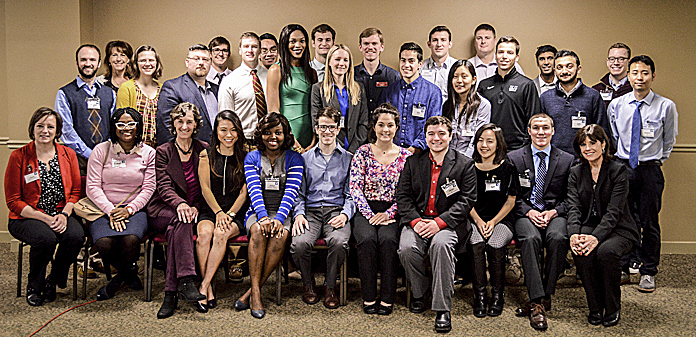
Kristy Hawley, MD (L) with Dr. Keith Smith of The Surgery Center of Oklahoma and other BRI student leaders at FMMA conference.
“My most memorable experience with BRI—and its greatest contribution to my professional and personal growth—was twice attending on scholarship the Free Market Medical Association (FMMA) conference in Oklahoma City.” ~Dr. Kristy L. Hawley
This was not my experience in medical school, nor is this the experience of most medical students I have met who are involved in the Benjamin Rush Institute. Medical students typically experience a one-sided healthcare policy approach that favors heavy government regulation. After almost 15 years of studying economics and health policy, my approach to improving healthcare involves getting back to basic principles of entrepreneurship and protecting the doctor-patient relationship. To reform our system, prevent physician burn out and increase job satisfaction successful systems of patient-centered care and “radical” ideas need to be researched. My goal during medical school was to acquaint colleagues and faculty to voices outside of academia. Working with BRI during medical school, we brought in innovative, entrepreneurial physicians who proved that both doctors and their patients can be happy and healthy. We heard from policy experts critical of the ACA who offered solutions for meaningful reform. These influential speakers are now found in the U.S. Senate, the office of the Commissioner of the U.S. Food and Drug Administration, featured frequently on national news outlets and are formidable forces in medical and doctor advocacy. The voices involved with BRI are determined to transform our current system.
My most memorable experience with BRI—and its greatest contribution to my professional and personal growth—was twice attending on scholarship the Free Market Medical Association (FMMA) conference in Oklahoma City. I networked with Dr. Keith Smith who invited BRI students to tour his Surgery Center. I could tell that the surgeons, staff and patients were enjoying the care delivery experience there. Dr. Smith walked us through how he set up the Surgery Center of Oklahoma, discussed difficulties and innovative solutions that have made the Center a national model for direct pay surgery. Due to his center’s phenomenal success, Dr. Smith has been asked to testify on healthcare matters on Capitol Hill. When choosing a specialty as a medical student it helps to see successful models in action. Having access to change leaders like Dr. Smith is invaluable for those thinking of practicing outside the traditional academic model.
“Some of the greatest opportunities in being involved with BRI are the relationships and education gained at national conferences. It was an amazing experience for me to meet people who shared similar visions for the future and promise of healthcare in our country. It was refreshing to speak with physicians fighting to reclaim ownership of our profession. We have lost our voice. We have lost our seat at the table to government regulations and insurers who now seem to make clinical decisions. We have allowed hospitals, rather than clinicians, to decide what is medically in our patients’ best interest.” ~Dr. Kristy L. Hawley
Our Hippocratic oath speaks of staying involved in society and preserving our profession so that we experience joy in healing: “I will remember that I remain a member of society, with special obligations to all my fellow human beings, those sound of mind and body as well as the infirm. If I do not violate this oath, may I enjoy life and art, respected while I live and remembered with affection thereafter. May I always act so as to preserve the finest traditions of my calling and may I long experience the joy of healing those who seek my help.”
My interactions with like-minded peers and experts who are working to return “joy” to the profession have given me the confidence to express my viewpoints with other physicians who may have different world views. I now have a network of physicians and fellow residents with whom I can discuss entrepreneurial or policy ideas. I truly loved getting to know the staff and BRI students across the country. I had such a wonderful experience and hope to pay it forward in the future. I urge medical students to please stay involved as residents, keep your email updated and maintain your BRI membership. As more students graduate there will be a greater role for resident mentorship as well as ways to focus on our own professional development.
“Using Healthcare Consumerism to Empower the Doctor-Patient Relationship”— Elaina George, MD
On February 2, 2017, Dr. Elaina George delivered the Keynote Luncheon Speech to medical students attending Benjamin Rush Institute’s Leadership Conference. Dr. George, a Board Certified Otolaryngologist from Atlanta is also on the board of Liberty HealthShare, a healthcare cost sharing ministry. Dr. George discusses how she rediscovered her love of practicing medicine in part due to innovations in the free market healthcare movement.
“Doctoring on Your Terms”—Julie Gunther, MD
Dr. Julie Gunther, a direct care doctor in Idaho, was a featured speaker at BRI’s 5th Annual Leadership Conference in St. Louis. In her talk, Dr. Gunther describes her journey to finding fulfillment and happiness in how she set up her own private practice, doctoring on her terms. Her patients are also benefitting from Dr. Gunther’s medical practice model. “Hippocratic Medicine in the Age of Population Health”—Michel Accad, MD
Dr. Michel Accad, a cardiologist based in San Francisco, was a featured speaker at BRI’s 5th Annual Leadership Conference 2017 in St. Louis. How did the shift in thinking about human beings starting with René Descartes influence our medical thinking today? Ask the Docs: Questions, Concerns, What is Direct Primary Care?—BRI Q&A Panel
At Benjamin Rush Institute’s 5th Annual Leadership Conference, we assembled a panel of doctors, students and professionals to address common medical student FAQs. Among questions addressed are: What are some of the concerns facing doctors today? What is the healthcare landscape going to be like for graduating medical students? And how does Direct Primary Care work? “Being Involved in Your Local Medical Society”—Trenton Schmale
Trenton Schmale, BRI-Marian chapter founder & past president talks about the importance of medical students being involved in their local and state medical societies so that they can impact legislative issues from the ground up. “Health 3.0: Healing Together, through the Person-Person Relationship”—Venu Julapalli, MD
Dr. Venu Julapalli is a gastroenterologist and founder of Integral Gastroenterology Center, one of the first fully direct-care, third-party-free GI practices in the nation. Author of Unique Self Medicine and Health 3.0, a movement to renew the future of medicine and health care through uniqueness, Dr. Julapalli also co-founded Conscious Medicine, a well-being program that integrates conventional with nonconventional medicine. Dr. Julapalli is incoming president of United Physician and Surgeons of America, which founded Let My Doctor Practice, a movement to restore the practice of health care to those who actually practice health care. “Why Independence Matters”—Marni Jameson Carey, Association of Independent Doctors (AID)
Marni Jameson Carey, executive director of the Association of Independent Doctors (AID), shares why medical independence is critical to providing the best care to the most people at most affordable prices, while simultaneously nurturing physicians and the patient-doctor relationship. “Finding the Joy”—Juliette Madrigal-Dersch, MD
Dr. Juliette Madrigal-Dersch owns a Med-Peds cash-based medical practice in Texas. In this video, she shares with the BRI leadership conference attendees her journey to establishing a practice that best serves her patients, her family and her lifestyle. “The Proper Role of Insurance”—Gayle Brekke MBA, FSA
Gayle Brekke, MBA, FSA, PhD Candidate, Kansas University Medical Center returns to Benjamin Rush Institute’s leadership conference to speak on the proper role of insurance. Understanding the distinction between healthcare and health insurance is critical to be able to craft healthcare policy that does the most good for the most people. “History of Government in US Medicine”—Beth Haynes, MD
Beth Haynes, MD is BRI’s executive director and explains the history of government in US medicine, which sheds light on why we find ourselves in today’s problematic healthcare policy climate. “What About the Poor?” How free markets address disparities—Beth Haynes, MD
Dr. Beth Haynes, BRI executive director, explains how free market healthcare policy solutions that promote competition, innovation and protect the patient-doctor relationship are the best way to ensure high-quality, affordable and accessible medical care for the most people.
“Is Healthcare a Right?”—Beth Haynes, MD
Dr. Beth Haynes, BRI executive director explains why as much as we may sympathize with the unexamined idea that healthcare is a right, there are many factors that must be considered, such as: If healthcare is a right, do we have a mandate to demand that certain people provide it? “BRI in Nigeria”—Aishat Olanlege
Aishat Olanlege heard of Benjamin Rush Institute through Students for Liberty, became a member, and founded one of the most impressive BRI chapters. Based in Ibadan, Oyo State, Ms. Olanlege understands that Nigeria’s healthcare challenges are not exactly like those in the US, yet, there are fundamental principles that transcend nations.
Dr. Pandelidis is an orthopedic surgeon with special training and expertise in the surgical and non-surgical treatment of back and neck disorders. Dr. Pandelidis’s practice is dedicated exclusively to spine care and orthopedics. He has been practicing medicine in the York, PA area for over twenty years.
The first component of replacement should be regulatory reform, or more accurately, reducing government interference in the private insurance market. Limiting the number of mandated coverages would allow individuals and families to buy the policies that best fit their medical and financial situations, and would allow insurance companies to sell policies that consumers want to buy. Insurance companies must be allowed to price premiums so that they reflect the actuarial risk. This would make the popular ObamaCare coverage of dependents up to the age of 26 years a non-issue. In an authentic insurance market, healthy young people would be charged appropriately low premiums. In conjunction with allowing sales of insurance across state lines, these provisions would spontaneously spawn a vibrant private sector national insurance exchange.
“Congress must have the courage and commitment to fully repeal ObamaCare and replace with policy restoring beneficial market forces to the private insurance market.” ~Dr. Nicholas Pandelidis
Deregulation would also encourage supply side innovation. As an example, companies could and would develop and sell policies that protect individuals from premium increases associated with developing an expensive medical condition. Such a policy in combination with extending the HIPPA protection (preventing loss of insurance for those who have continuously maintained their insurance coverage if they were to develop an expensive medical condition) to the individual market would be a significant step to fully addressing the pre-existing medical illness problem.
Expanding the Role of Health Savings Accounts
Replacement’s second component should promote Health Savings Accounts (HSAs) by making them tax advantaged and allowing them to be passed on to heirs. The combination of the availability of high deductible/catastrophic policies with HSAs would begin the beneficial shift away from 3rd party payment.
Personal Ownership of Private Health Insurance
The final component of replacement would promote individual purchase of healthcare insurance – moving away from employer provision – by providing a refundable tax credit for individuals/families to put toward buying the policy that best fits their individual situations. This could be done in a revenue neutral way by shifting the foregone tax revenues from employer provided insurance to this new benefit.
These reforms will repair and transform the private insurance market. Individuals choosing and buying, insurers innovating, competing, and selling will drive down costs and elevate service and quality. As reform corrects the government created perverse incentives in the private healthcare market, hundreds of billions of dollars of the current $3.2 trillion US annual healthcare expenditure will flow back into the private economy – growing businesses, increasing employment, raising wages, and making American companies more competitive in the global economy.
Fix Private Insurance – then tackle Medicare and Medicaid
The replacement components are clear but the political path forward, problematic. The opportunity to repair the harm done to the private healthcare market by government regulation must not be lost. While it may be tempting to also pass reforms that would put Medicare and Medicaid on sustainable paths, and to practicably address unaffordable premiums for those with expensive pre-existing medical conditions, it is a bridge too far. And “compromise” half-measures on everything would be no reform at all.
The Republicans should neutralize any demagoguery from the left that “conservatives” don’t care about the poor and sick by putting forward provisions allowing those newly qualified for Medicaid to keep that coverage, and for those with pre-existing conditions who can’t afford their premiums to enroll in Medicare, Medicaid, or an income-based federal premium subsidy program.
While there are better and more viable free market solutions for these two problems, such provisions would provide unassailable political cover to get the critical deregulation of the private insurance market done. Better to fix the private markets now, and to take on Medicare and Medicaid reform later.
A few words on the deficit
A few words on the deficit: Fiscal conservatives rightly worry over deficits but the bigger immediate problem is taxes and regulation that confiscate capital that would be most productively allocated in the private sector, rather than less effectively if not out and out wastefully spent by the government. That bleeding of the private economy throttles economic growth. The long-term solution to the deficit is certainly not higher taxes, and further, not necessarily less government spending per se, but rather tax/regulatory/fiscal policy resulting in the economy growing faster than government spending. If that happens, the deficit problem slowly, steadily, and unfailingly resolves.
Congress must have the courage and commitment to fully repeal ObamaCare and replace with policy restoring beneficial market forces to the private insurance market.
Transformational healthcare market reform will lower healthcare insurance and healthcare cost, grow employment and the economy; and growing the economy is the foundation for credibly lowering the national debt.
[Ed. Note: Dr. Beth Haynes met Dr. Pandelidis through the Docs4PatientCare Foundation and originally read this article in one of the D4PC newsletters. It is reprinted here with Dr. Pandelidis’s permission.]
Dr. Beth Haynes, BRI executive director speaks about the theme and purpose of Benjamin Rush Institute’s 5th Annual Leadership Conference. Physician and medical student suicide is on the rise; many call it epidemic.
BRI postulates that the best way to save physicians and healthcare professionals is to preserve their direct relationship with their patients, without undue regulation and government interference.
[/et_pb_text][et_pb_cta admin_label=”Contact Us Call to Action” _builder_version=”3.0.106″ button_text=”Contact Us” button_url=”http://www.benjaminrushinstitute.org/contacts/” url_new_window=”off” background_color=”#25756c” use_background_color=”on” background_layout=”dark” custom_button=”off” button_icon_placement=”right” saved_tabs=”all” global_module=”13772″ title=”Want to Learn More?” /][/et_pb_column][/et_pb_row][/et_pb_section]